
Research programs

Two computational programs on public data. Each is described by its question, its method, its data and its status, including what has not been done.

R-001

Adaptive Biological Discovery

When does choosing the next genetic perturbation experiment with a model beat choosing at random, and how should that be measured fairly?

Method
Retrospective simulation on public perturbation screens, scored against independent measurements, with negative controls and decision rules fixed in advance.
Data
Public single-cell perturbation screens under open licences.
Computational analysis
In progress
Protocol public
Not run
Independent replication
Not run
Experimental validation
Not started

Simulation on existing data is not a prospective experiment. Nothing here has been validated in a laboratory.

Conceptual illustration: a network of points on a deep navy field; some points are chosen and ringed with dashed circles, others are marked by hollow squares.
Conceptual illustration, AI-generated. Dashed rings mark experiments chosen by a strategy; squares mark a held-out reference panel. No data are shown.

R-002

Virtual Tissue Laboratory

What can a multicellular simulation honestly tell us about tissue organisation, and which of its predictions can be tested against measurements?

Method
Cellular Potts models in established open-source software, numerical verification, and comparison against public quantitative experiments only where the experiment matches the model.
Data
Published quantitative datasets, used only within their licences.
Numerical verification
In progress
Biological validation
Blocked
Protocol public
Not run
Experimental validation
Not started

A simulation that reproduces a pattern does not show the pattern has that cause. Biological validity is not claimed.

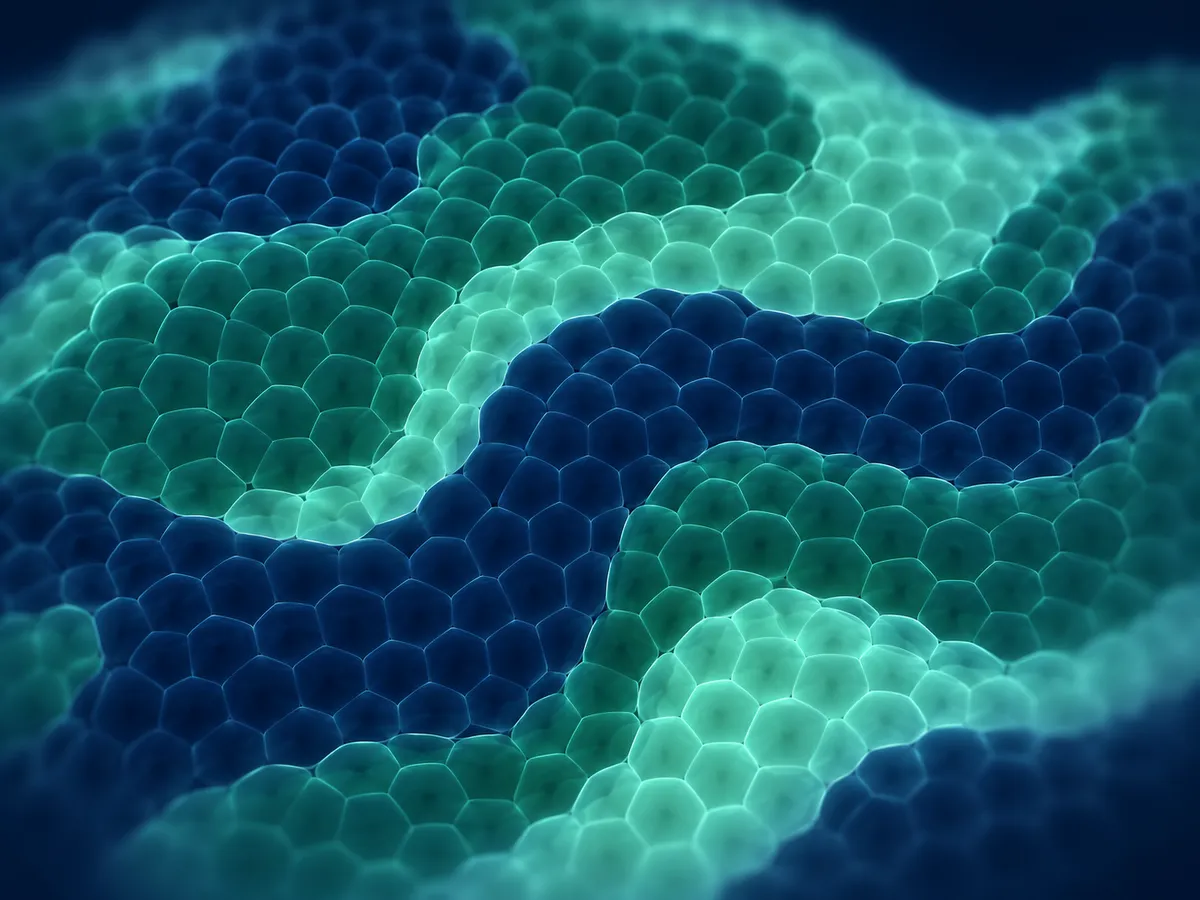
Conceptual illustration: a packed mosaic of translucent cells in navy and teal tones forming flowing domains.
Conceptual illustration, AI-generated, of a simulated tissue. It is not simulation output and not a microscope image.